M Meshy

Production guide

Use Meshy AI for 3D Modeling With a Production Mindset

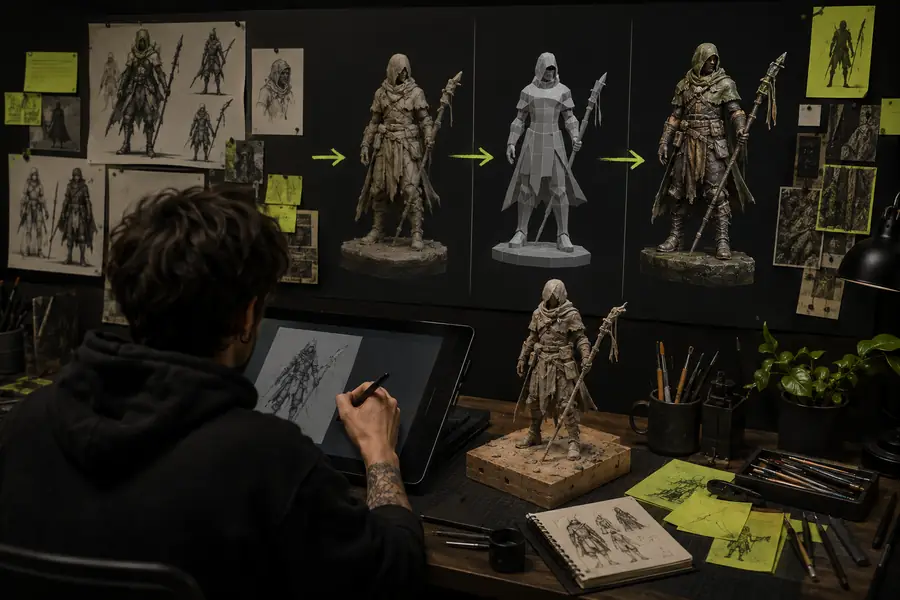
Meshy AI for 3D modeling helps artists move from a written concept or reference image to a workable asset draft. The strongest results come from treating generation as an early production step, not a replacement for modeling judgment.

3
core workflow paths
1
review loop before delivery
0
assumption that generation is final
A generated 3D asset shown in a modeling workflow

People and projects

The scenario's pain

Different 3D teams feel the same bottleneck in different ways: too much time goes into blocking, searching, and revising before the real creative decision can begin.

Indie game designer

You need several readable props for a prototype, but spending hours on each low-priority asset would slow the playable build.

Generate a first-pass prop, test its silhouette in the scene, then spend manual time only on assets that survive review. The how to use Meshy AI guide explains a practical prompt-to-export sequence.

how to use meshy ai

Product visualizer

A client describes a product concept before engineering files exist, leaving you with little more than a sketch, mood board, or phone photograph.

Use image references to establish form and proportion quickly, then refine the approved direction in a conventional 3D package. Meshy AI online describes the browser-based path for getting from reference to draft.

Meshy AI online

Character and environment artist

You want to compare several visual directions for a creature, building, or prop before committing to a detailed sculpt or retopology pass.

Create multiple rough variants, evaluate them against the brief, and keep the strongest design as a blockout. The Meshy AI examples collection offers ideas for choosing useful test subjects.

Meshy AI examples

Educator or learner

A class needs visible 3D references for explaining form, composition, or asset pipelines, but not every lesson justifies building polished assets from scratch.

Generate teaching examples, annotate the weak areas, and use them to discuss topology, materials, and proportion. What is Meshy AI gives a plain-language overview before students begin.

What is Meshy AI
Choose your path

3 concrete workflows

The right route depends on the input you have and the finish level you need. Use generation to reduce uncertainty, then choose the amount of manual work that the asset deserves.

1

You have a clear written concept but no visual reference.

Start with text-to-3D prompts that name the subject, style, materials, camera intent, and important exclusions.

Text is fastest for exploring broad directions, but it leaves more room for unexpected proportions and surface details. Generate several candidates rather than overworking one prompt.

2

You have a strong image, sketch, or product photograph.

Use image-to-3D as a shape guide, then inspect the result from angles the reference does not show.

A reference can anchor silhouette and visual language more reliably than prose. It still cannot communicate hidden geometry, exact dimensions, or every construction detail.

3

You need an asset for a real-time scene or downstream pipeline.

Treat the generated model as a draft: inspect scale, normals, materials, polygon distribution, naming, and export behavior before integration.

A visually convincing preview can still require retopology, UV repair, texture edits, rigging, or collision setup. The workflow succeeds when it saves decisions, not when it skips validation.

Example output

Example output

A useful result is more than an attractive turntable. For a stylized market stall, the deliverable should be judged by how well it supports the next production decision.

The stall reads clearly at the distance and camera angle used in the scene.
01 silhouette
Front and three-quarter inspection reveal whether the generated form holds together beyond the source reference.
02 views
A generation pass, cleanup pass, and integration check separate exploration from delivery.
03 passes
Scale, topology, materials, and export settings are reviewed before the asset reaches a shared project.
04 checks

Quality and safety

Compliance notes

AI-generated 3D assets can accelerate production, but responsibility remains with the person who selects, edits, and publishes the result.

It cannot guarantee production-ready topology

A model may look complete while containing uneven density, stretched polygons, disconnected surfaces, or geometry that is difficult to animate.

WorkaroundUse it for ideation and blockout, then retopologize or simplify the mesh according to the target engine and asset budget.

It cannot infer hidden dimensions with certainty

One image or a short prompt does not establish the back, underside, internal structure, or exact measurements of an object.

WorkaroundSupply multiple references when possible and verify critical dimensions against drawings, scans, or known scale.

It cannot clear every right or likeness concern

A generated result may resemble a protected character, branded product, recognizable artwork, or a person more closely than intended.

WorkaroundReview source references and outputs, remove identifying elements, document approvals, and obtain permission where your project requires it.

It cannot replace artistic or technical review

Material artifacts, implausible joins, incorrect openings, and inconsistent details can survive a quick preview and become expensive later.

WorkaroundSet a review checklist, inspect the asset from multiple angles, and test it in the actual scene or pipeline before publication.

Before you begin

Scenario FAQ

Use this short checklist to decide whether the workflow fits your project and what evidence to collect before calling an asset finished.

Required

Is meshy ai good for 3D modeling?

It is useful for concept exploration, blockouts, references, and selected production assets. It is not a universal substitute for topology, UV, rigging, or technical art work.

Required

Do you have a defined use for the generated asset?

Write down whether the result is for ideation, a still image, a prototype, a game scene, a lesson, or a final deliverable. The required finish level changes with the use.

Required

Can you provide a clear prompt or suitable reference image?

Describe the subject, style, materials, and exclusions, or choose a reference with a readable silhouette and enough visual information to guide the result.

Required

Will someone inspect and edit the model before delivery?

Assign a person to check geometry, scale, materials, rights, naming, and export behavior. A review owner prevents a draft from being mistaken for a finished asset.

Optional

Do you need exact dimensions, animation, or manufacturing precision?

If yes, plan a conventional modeling and validation phase after generation. Use the AI output as a reference or starting point rather than the authoritative source.